





Bitcoin price stabilized near the $78,000 level on Thursday as easing geopolitical tensions, slowing ETF outflows, and improving technical indicators helped bulls defend a critical support zone.
Summary
- Bitcoin price stabilized near $78,000 as Trump said U.S.-Iran negotiations were nearing completion, easing fears of prolonged Strait of Hormuz disruptions.
- Spot Bitcoin ETF outflows slowed to $70 million on Wednesday after investors withdrew $648 million on Monday and $331 million on Tuesday.
- SpaceX disclosed holding 18,712 Bitcoin in an SEC filing, exceeding earlier estimates and placing its BTC treasury above Tesla’s.
According to data from crypto.news, Bitcoin (BTC) traded at $77,960 at press time after touching an intraday high of $78,180. The recovery came as broader risk sentiment improved following comments from U.S. President Donald Trump suggesting negotiations with Iran could soon reach their final stage.
Markets reacted sharply to the development because a successful agreement could eventually restore smoother commercial shipping activity through the Strait of Hormuz, where disruptions since March have fueled persistent concerns over global energy supplies.
WTI crude futures traded above $99 per barrel on Thursday but remained well below the previous session’s highs after Trump’s remarks reduced fears of a prolonged supply shock. Oil had previously surged as traders priced in the risk of escalating maritime disruptions in the Middle East.
Bitcoin and other risk assets have remained highly sensitive to oil price movements in recent months because elevated energy costs could complicate the Federal Reserve’s inflation outlook and delay potential interest rate cuts.
Another positive signal emerged from the U.S. spot Bitcoin ETF market. Net outflows slowed sharply to $70 million on Wednesday after investors withdrew $648 million on Monday and another $331 million on Tuesday, suggesting institutional selling pressure may be cooling.
The slowdown in ETF redemptions arrived as Bitcoin attempted to reclaim key resistance near the $78,000 region, which has repeatedly acted as a short-term supply zone throughout May.
Meanwhile, Elon Musk-linked Space Exploration Technologies Corp., better known as SpaceX, disclosed holding 18,712 Bitcoin in its latest S-1 registration filing with the U.S. Securities and Exchange Commission.
The filing revealed a substantially larger Bitcoin treasury than earlier blockchain-tracking estimates. Previous Arkham-linked estimates cited by crypto.news had placed SpaceX holdings near 8,285 BTC, meaning the company officially disclosed more than 10,000 additional Bitcoin beyond prior estimates.
The disclosure also showed that SpaceX now holds more Bitcoin than Tesla, further strengthening the narrative that Musk-related firms continue maintaining sizable long-term crypto exposure despite heightened market volatility this year.
SpaceX’s Bitcoin holdings were disclosed as part of one of the most closely watched IPO filings of 2026. The company is reportedly preparing for a Nasdaq listing in June that could value the aerospace giant between $1.75 trillion and $2 trillion.
Is Bitcoin’s double bottom pattern pointing toward a breakout?
Bitcoin’s weekly chart shows the asset forming a clear double bottom pattern around the $64,000 to $66,000 region after defending that support area twice between February and April.
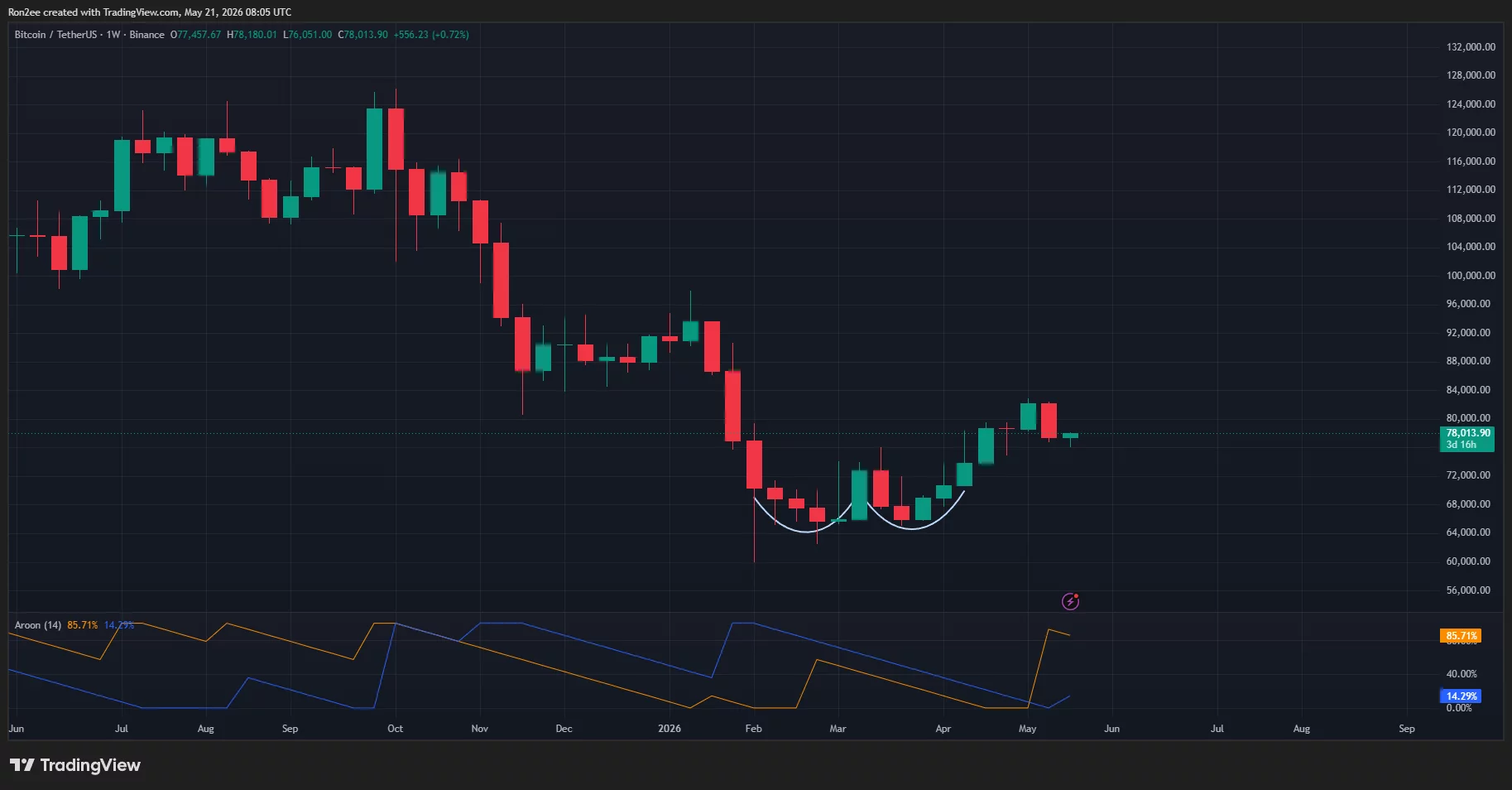
The neckline resistance of the pattern currently sits near the psychological $80,000 level, an area Bitcoin has struggled to reclaim decisively over the past several weeks.
From a technical analysis perspective, double bottom formations are generally viewed as bullish reversal patterns because they signal weakening bearish momentum after repeated failed attempts to break lower.
Momentum indicators are also beginning to favor bulls. The Aroon Up indicator has climbed to 85.71% while the Aroon Down indicator has dropped to 14.29%, reflecting strengthening upward momentum and fading bearish pressure.
The daily chart additionally shows Bitcoin continuing to trade above its Supertrend support level near $75,560, a zone that has acted as an important short-term floor during May’s consolidation phase.
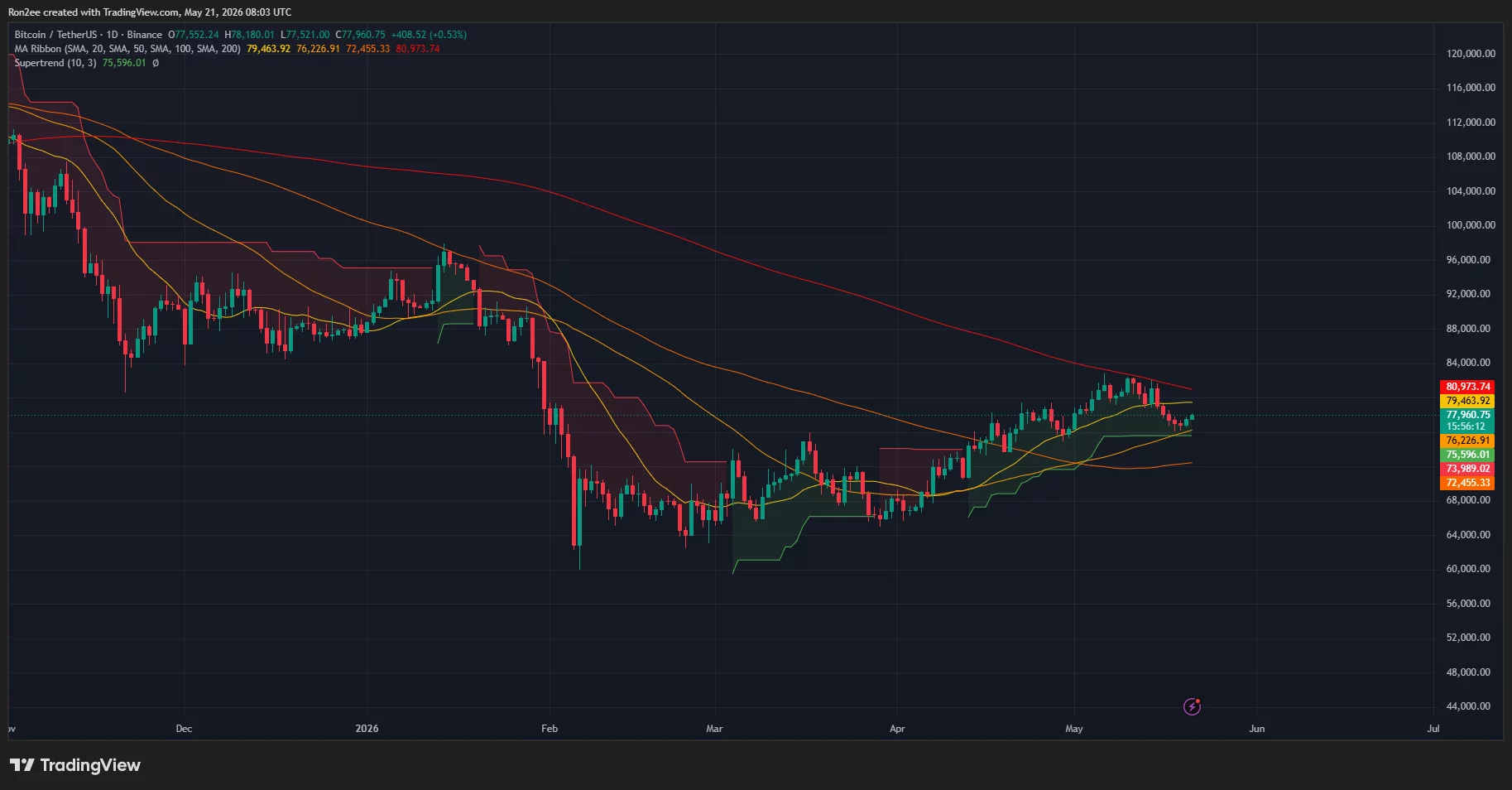
Bitcoin also remains above both the 50-day and 100-day moving averages, currently positioned near $76,226 and $72,455, respectively, suggesting medium-term trend structure remains constructive despite recent volatility.
However, the 200-day moving average near $80,973 continues acting as a major overhead resistance barrier. A decisive breakout above that level could strengthen the probability of a broader bullish continuation.
Classical breakout projections for a confirmed double bottom are typically calculated by measuring the distance between the neckline and the bottom formation before extending that range upward from the breakout point.
Using that methodology, Bitcoin could potentially target the $92,000 to $95,000 region if bulls successfully reclaim the neckline resistance near $80,000.
Where are the key Bitcoin liquidation levels?
Derivatives positioning suggests volatility may intensify as Bitcoin trades near several large liquidity clusters identified by CoinGlass heatmap data.
On the upside, major short liquidation zones are concentrated between $78,000 and $81,000. If Bitcoin breaks into that range, forced liquidations from leveraged short positions could accelerate bullish momentum.
Crypto analyst Ted Pillows highlighted the growing liquidity imbalance in a recent post on X.
“BTC has formed decent liquidity clusters both to the upside and downside,” Ted Pillows said.
He added that “there’s a good chunk of liquidity sitting around the $78,000–$81,000 level,” while warning that a “huge liquidity cluster” remains below the $76,800 area.
CoinGlass liquidation maps also show elevated leverage concentration around the $76,500 to $77,000 region, meaning downside volatility could accelerate quickly if Bitcoin loses nearby support.
That downside risk remains important because broader macro uncertainty has not fully disappeared. Any setback in negotiations between Washington and Tehran could quickly revive fears of prolonged supply disruptions in the Middle East.
Higher oil prices could also reinforce inflationary pressures at a time when investors remain highly sensitive to Federal Reserve policy expectations and global liquidity conditions.
Still, Bitcoin bulls appear encouraged by the combination of easing ETF outflows, improving technical momentum, and renewed institutional validation from SpaceX’s treasury disclosure.
For now, traders remain focused on whether Bitcoin can decisively reclaim the $80,000 neckline resistance zone, which may determine whether the developing double bottom pattern evolves into a larger recovery rally toward the mid-$90,000 range.
Disclosure: This article does not represent investment advice. The content and materials featured on this page are for educational purposes only.