





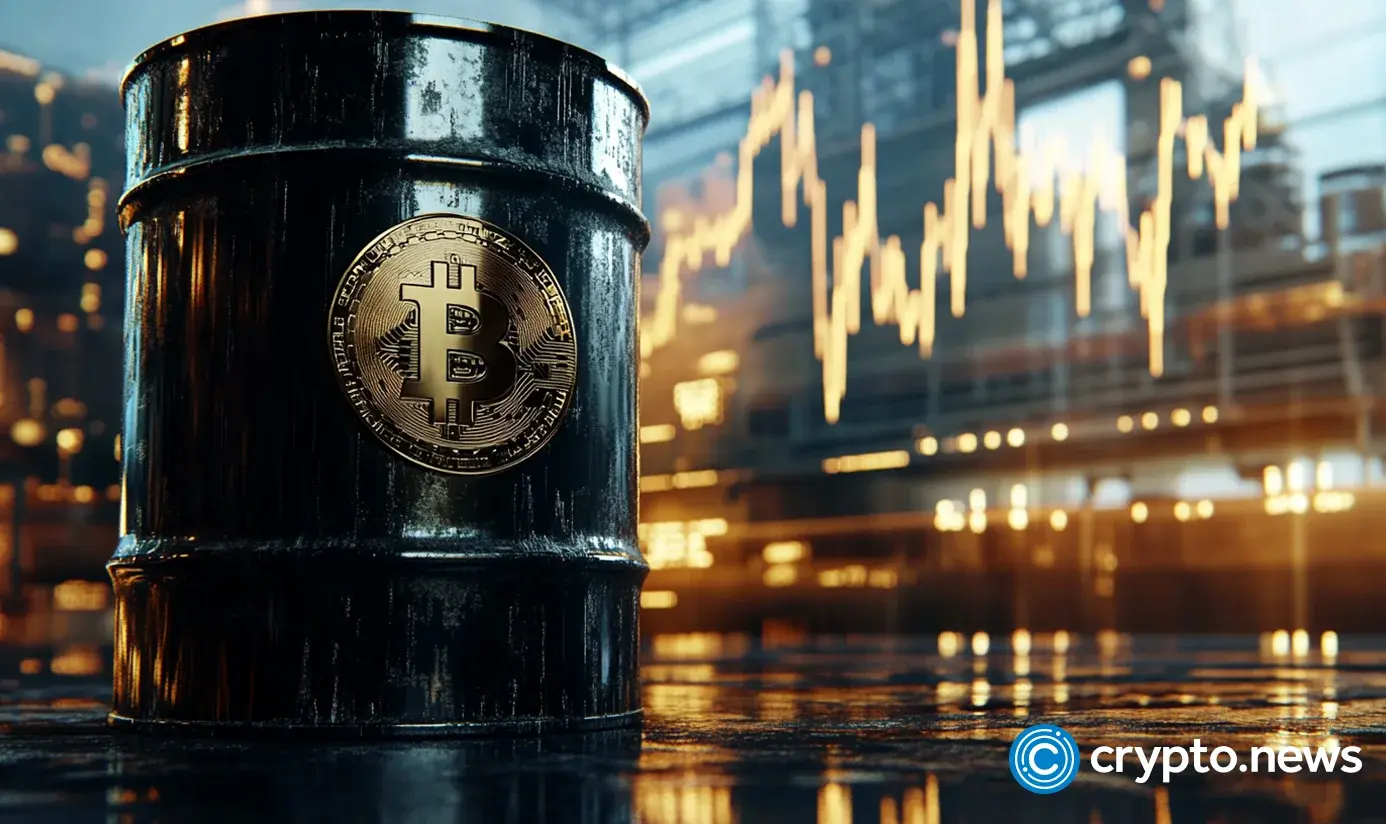
Oil tops $100 as the Hormuz blockade chokes 20% of global supply, forcing a rare Jones Act waiver and stoking inflation that threatens Fed cuts and crypto risk appetite.
Summary
- Brent trades above $104 and WTI near $97, more than 70% above January levels, as the U.S.-Israel war on Iran effectively shuts the Strait of Hormuz.
- The Trump administration’s 60‑day Jones Act waiver lets foreign tankers move fuel between U.S. ports, but estimates suggest only modest relief for gasoline prices.
- Surging energy costs flow into PPI and future CPI, keeping Fed cuts on hold and adding macro pressure to Bitcoin and broader crypto as risk assets reprice.
Oil markets remain in a state of acute stress on Wednesday, with Brent crude trading above $104 per barrel and West Texas Intermediate crossing $97, as the geopolitical fallout from the U.S.-Israel war on Iran continues to reverberate through global energy supply chains. The moves represent a price surge of more than 70% since early January, when Brent was hovering around $60 a barrel — and come as the Trump administration reached for one of its most unconventional policy levers yet: a waiver of the century-old Jones Act.
The White House confirmed Wednesday that it had temporarily authorised foreign-flagged vessels to transport energy commodities — including crude oil, refined oil, natural gas, natural gas liquids, fertilizers, and other derivatives — between U.S. ports for a period of 60 days. The Jones Act, formally the Merchant Marine Act of 1920, ordinarily mandates that goods shipped between American ports be carried exclusively on U.S.-built, U.S.-flagged, and U.S.-crewed vessels. Waivers have historically been reserved for acute national emergencies such as hurricanes or severe supply crises.
The root cause is the effective closure of the Strait of Hormuz, through which approximately 21 million barrels of oil per day — roughly 20% of global supply — normally flow. Since U.S. and Israeli forces struck Iran on February 28, killing Supreme Leader Ali Khamenei and triggering a sweeping Iranian retaliation, Iran’s Islamic Revolutionary Guard Corps has mined the strait, attacked commercial vessels, and vowed to maintain the blockade. The IEA has characterised the disruption as the largest to global oil supply in modern history.
The consequences for physical markets have been severe. Middle Eastern Gulf oil exports have dropped by over 60% in under a week, with producers including the UAE forced to cut output as onshore storage fills and export routes remain blocked. War-risk insurance premiums have surged to levels that make commercial transit economically prohibitive for most vessels, while over 50 million barrels of Gulf crude is now stranded in floating storage. The IEA’s emergency release of 400 million barrels from member-state strategic reserves has done little to reassure markets.
Reuters reported that Brent futures settled up $3.21, or 3.2%, to $103.42 on Monday — before extending gains further through Tuesday and into Wednesday’s session. Analysts at Energy Intelligence have warned of no near-term ceiling if the blockade persists.
The Jones Act waiver is the administration’s domestic response to soaring pump prices, which have risen roughly 60 cents per gallon to $3.60 since the war began. By allowing cheaper foreign tankers to ferry Gulf Coast oil to refineries on the U.S. East Coast and West Coast — routes where the Jones Act constraint is most acute — Washington hopes to ease regional supply bottlenecks. However, the measure’s macroeconomic impact is widely expected to be modest. Bloomberg cited a JP Morgan estimate suggesting the waiver could save East Coast motorists roughly 10 cents per gallon, while OilPrice.com analysts noted it is unlikely to offset the broader global shock driven by the Hormuz blockade itself.
For crypto and financial markets, the oil surge carries compounding implications. Higher energy prices feed directly into the U.S. Producer Price Index — which already printed at double its expected rate on Wednesday — further entrenching the inflation stickiness that is keeping Federal Reserve rate cuts off the table and suppressing risk appetite across asset classes.